Yu Qi Northeastern University
Ph.D. Student in Computer Science
I am a rising fourth-year CS Ph.D. student at Northeastern University, advised by Prof. Lawson L. S. Wong. Before that, I received my B.S. in Computer Science from Peking University in the year of 2023.

Research
My research focuses on the post-training — SFT and RL — of robot policy models. More specifically, I am interested in the following questions:
- How does post-training data shape generalization? Scalable post-training data collection and bias-aware evaluation that expose the hidden biases limiting compositional generalization. (Scale Up Strategically, Two by Two)
- How do pre-trained models help — and where do they fail? Diagnosing and enhancing the embodied and reasoning abilities of foundation and video models. (BEAR, MME-CoT, MME-CoF, MME-CoF-Pro)
- How can embodied systems reason and act reliably? Structural inductive biases — equivariance, object-centric skills — for sample-efficient, generalizable control. (EquAct, Hierarchical Skill Learning)
News
- 2026🎉 Scale Up Strategically accepted to CoRL 2026.
- 2026🎉 Our workshop G2A: From Generative Models to Robot Actions is accepted at CoRL 2026.
- 2026🎉 MME-CoF-Pro accepted to ECCV 2026.
- 2026🎉 BEAR accepted to ICML 2026.
- 2026🎉 MME-CoF accepted to CVPR 2026 (Findings).
- 2026🎉 EquAct accepted to ICLR 2026.
- 2025🎉 EquiTac and GSL accepted to IEEE RA-L.
- 2025🎉 MME-CoT accepted to ICML 2025; Two by Two accepted to CVPR 2025.
- 2024🎉 ThinkGrasp accepted to CoRL 2024.
- 2023Started my Ph.D. at Northeastern University.
- 2019Started my bachelor at Peking University, where dream begins.
Selected Publications
Full list on Google Scholar.
 CoRL
CoRL2026
A diagnostic framework and post-training data-collection recipe for compositional generalization, attributing policy shortcuts to individual instruction factors such as color, verb, object, and spatial relation.
 arXiv
arXiv2026
A 3D closed-loop manipulation policy that predicts actions as pixel classification over camera-plane action maps, avoiding the token explosion of discretized action spaces.
 CVPRW
CVPRW2026
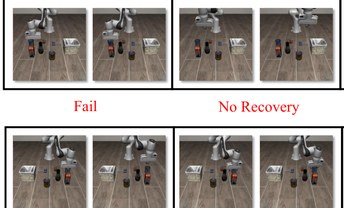
A reinforcement learning framework that trains the world model and action model jointly through online interaction, pushing world-action policies beyond their demonstration data.
 ECCV
ECCV2026
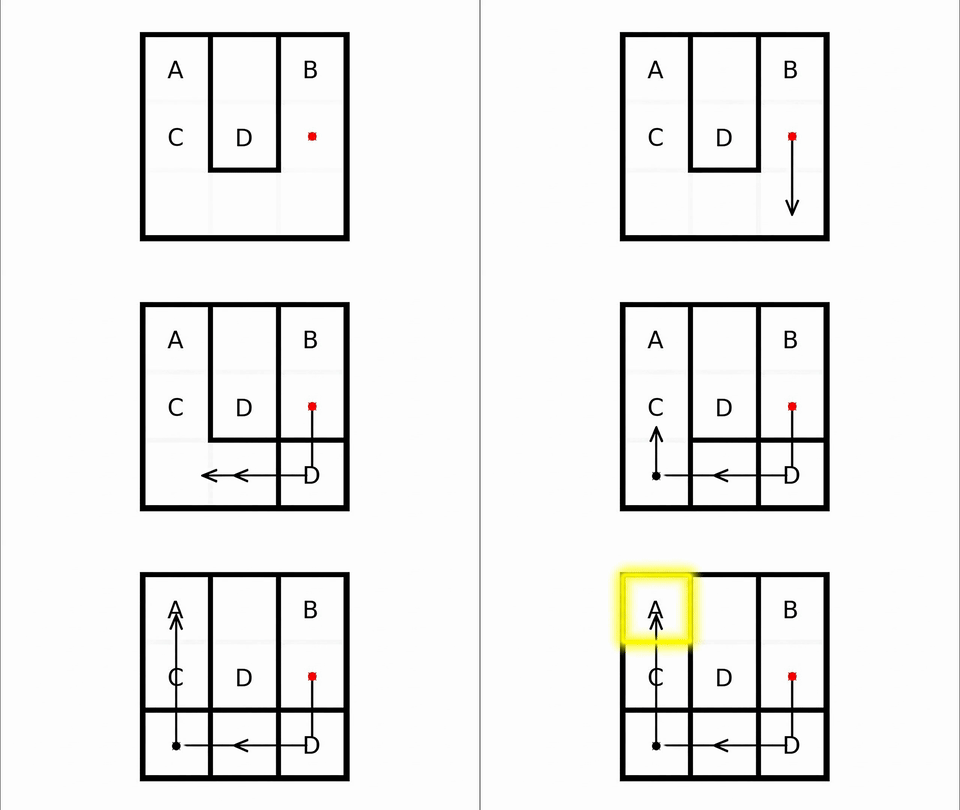
A video reasoning benchmark for reasoning coherence — whether generated events stay causally consistent across frames — evaluated with and without text and visual hints.
 ICLR
ICLR2026
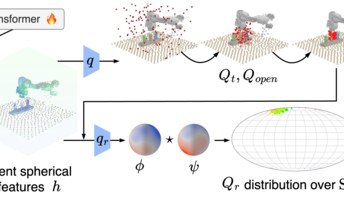
An SE(3)-equivariant multi-task transformer for language-conditioned 3D manipulation, guaranteeing that policy behavior stays consistent under rotations and translations of the scene.
 CVPR
CVPR2026
A benchmark and empirical study of video generation models as zero-shot reasoners, spanning spatial, geometric, physical, temporal, and embodied reasoning.
 ICML
ICML2026
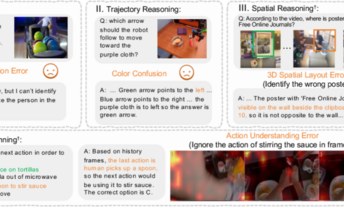
A skill-level embodied benchmark, plus BEAR-Agent, an embodied agent that calls visual and spatial reasoning tools — drawing on its own observations — to solve embodied tasks.
 RA-L
RA-L2025
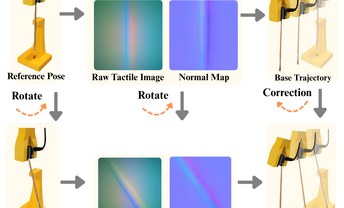
A visuotactile policy that predicts residual in-hand rotation with an SO(2)-equivariant network over surface normals reconstructed from tactile images.
 RA-L
RA-L2025
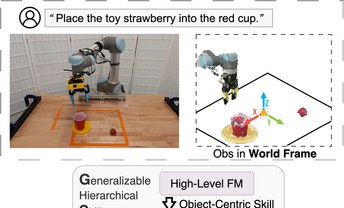
A hierarchical skill-learning framework that uses object-centric skills to connect a high-level vision-language model with low-level visuomotor policies.
 ICML
ICML2025
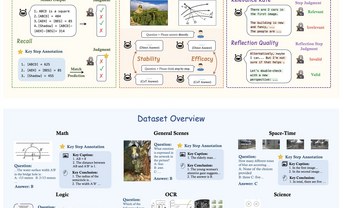
A benchmark for chain-of-thought reasoning in large multimodal models, measuring reasoning quality, robustness, and efficiency across six domains.
 CVPR
CVPR2025
A large-scale dataset and multi-task policy for daily pairwise object assembly, covering everyday tasks such as plugging into sockets and arranging flowers in vases.
 CoRL
CoRL2024
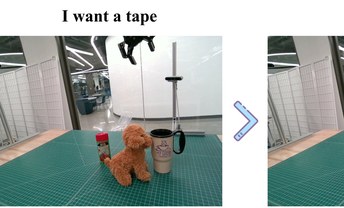
A vision-language grasping system that reasons with GPT-4o about which object to clear next, uncovering and grasping targets in heavy clutter.
 arXiv
arXiv2026
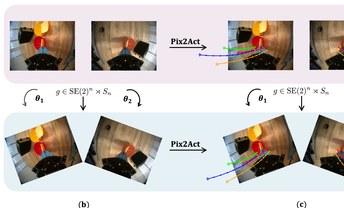
An imitation-learning method that represents manipulation as image-space keypoint trajectories, recovering 3D end-effector poses by triangulation and enabling equivariant augmentation.
Academic Services
- Workshop OrganizerConference on Robot Learning (CoRL)
- Conference ReviewerCVPR, ECCV, ICCV, ICLR, ICML, CoRL, NeurIPS, RSS, ICRA